CPT Testing
Where Innovation Meets Groundbreaking Insight
For engineering and construction projects in Whangarei, we have a soil-tastic solution and that’s CPT.
Cone Penetration Testing (CPT) is the fastest, most cost-effective method for gathering accurate subsurface data. As CETANZ members, Soil + Sample follows best practice CPT procedures in accordance with ASTM D5778 and ISO 22476-1 standards — delivering reliable geotechnical data across Northland and North Shore.
Our cone penetrometer is pushed into the ground at a controlled, constant rate — continuously measuring tip resistance (qc), sleeve friction (fs), and pore water pressure (u2) at 20mm intervals through every soil layer. This continuous data profile gives engineers a highly detailed picture of subsurface conditions without the need for intrusive drilling.

Precision Insights
Obtain accurate and detailed information about soil composition and properties.

Efficiency
CPT allows for rapid data collection, reducing time and costs compared to traditional methods.
.png "geotechnical-1-.png")
Real-time Analysis
Receive immediate on-site results, enabling prompt decision-making during the testing process.

Comprehensive Data
Assess soil strength, stratigraphy, and other key parameters for a holistic understanding. Utilises a smaller cone for investigations in confined spaces or areas with limited access.
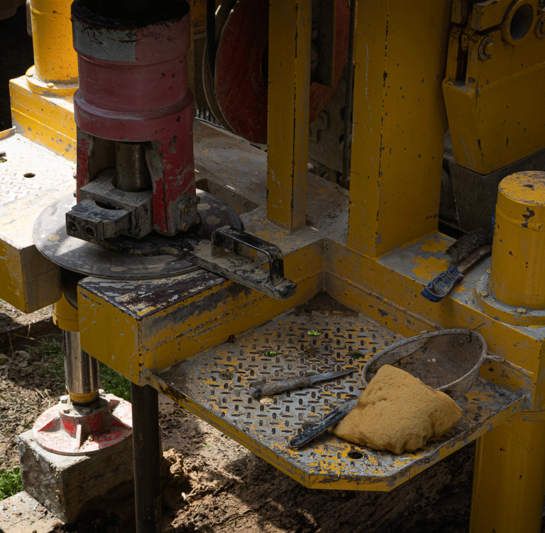
Let’s kick a few rocks out of the way - Cone Penetration Testing (CPT) is a widely employed geotechnical investigation intended for foundation design, site suitability assessments, and a method in understanding the mechanical properties of the subsurface materials.
CPT is the preferred investigation method for foundation design, liquefaction assessment, land development consent reports, settlement analysis, and slope stability assessments. Our local knowledge of Northland soils — from the volcanic and weathered profiles of the Far North to the soft estuarine deposits around Kaipara Harbour and Marsden Point — means you get results interpreted with real regional expertise.
As Northland's dedicated CPT specialists and proud CETANZ members, Soil + Sample provides CPT testing across Whangarei, Far North, Kaipara, and North Shore. We service all areas from the North Shore to Cape Reinga, and anywhere else by prior agreement. Contact us on 09 553 3791 to discuss your investigation requirements.
Dig Deeper, Build Smarter
CPT - Your Path to Solid Foundations
Cone Penetration Testing (CPT) includes various types of testing methods to gather specific information about the soil and subsurface conditions.
A variety of CPT testing we can do for you:
FAQs - Cone Penetration Testing (CPT)
Whether you're new to CPT or seeking a deeper understanding, explore our commonly asked questions here at Soil + Sample and get to know more about this powerful geotechnical method.
1. What is Cone Penetration Testing (CPT)?
Cone Penetration Testing is a geotechnical method that involves pushing a cone-tipped probe into the ground to measure soil properties. It provides valuable data on soil composition, strength, and stratigraphy.
2. How does CPT differ from traditional drilling methods?
Unlike traditional drilling methods, CPT is non-intrusive and minimises soil disturbance. It allows for real-time data collection during penetration, offering a more efficient and cost-effective approach to geotechnical investigations.
3. What information does CPT provide?
Our CPT testing in Whangarei provides information on cone tip resistance, sleeve friction, and pore water pressure. These parameters help in assessing soil strength, stratigraphy, and hydraulic characteristics, essential for foundation design and construction planning.
4. In what types of projects is CPT commonly used in Whangarei?
CPT is commonly used in a variety of projects around Whangarei, including foundation design for buildings, bridges, and offshore structures. It's also employed in environmental assessments, infrastructure development, and geotechnical investigations for soil characterisation.
5. Is CPT suitable for all soil types?
Yes, CPT is versatile and can be applied to various soil types, including sands, clays, and silts. Its adaptability makes it a valuable tool in Whangarei geotechnical engineering, offering insights into soil behaviour across different geological conditions. Call us at Soil + Sample to know more.
Precision in Every Soil Particle
Our Soil Tests Lead the Way in Whangarei
From soft estuarine clays to dense volcanic profiles, our tracked testing rig reaches sites that conventional equipment cannot — including steep slopes, marshy ground, and areas with restricted access. Single-operator capability keeps your investigation efficient without compromising data quality.